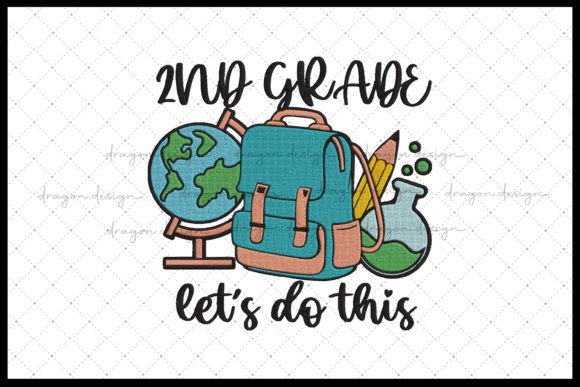
2nd Grade Let's Do This
A Practical Design Review for Small Business Merchandise & Branded Patches
As an embroidery designer who’s developed hundreds of commercial embroidery files for boutiques, cafés, florists, pet brands, and handmade studios, I approach every new design with two questions: Does it communicate brand confidence at a glance? and Will it hold up across real-world production variables? When I first saw 2nd Grade Let's Do This, my instinct was to pause—not because it’s flashy or complex, but because its energy is so deliberately human. It reads as warm, encouraging, and authentically school-year hopeful—not generic back-to-school clipart. That tone matters deeply when you’re stitching it onto aprons for a neighborhood bakery, embroidering it on tote bags for a local florist’s pop-up, or turning it into a woven patch for a children’s clothing line.
First Impression: Friendly, Confident, and Commercially Versatile
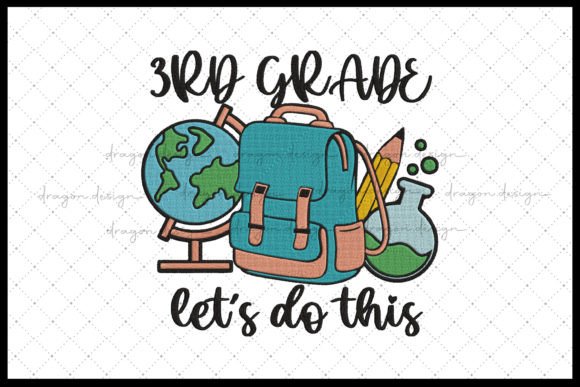
2nd Grade Let's Do This lands as playful yet professional—neither overly cutesy nor stiffly corporate. The phrasing carries quiet authority (“Let’s do this”) while the grade-level context grounds it in sincerity and growth. That duality makes it unusually flexible for small business merch: it works as a chest logo for a creative studio’s staff uniforms, a subtle sleeve detail on a café’s barista apron, or even a cheerful accent on product packaging tags for handmade goods. Unlike many back-to-school embroidery designs that lean heavily into apples, pencils, or chalkboard motifs, 2nd Grade Let's Do This avoids visual cliché—giving your brand room to own its voice without competing with literal iconography.
Real-World Performance Across Business Applications
In practice, 2nd Grade Let's Do This shines where clarity and emotional resonance matter most. As an embroidered patch, it reads cleanly at 2.5"–3.5" width—ideal for sew-on branding on tote bags, denim jackets, or reusable lunch kits sold by eco-conscious shops. On cap embroidery, it holds well on structured front panels when digitized with balanced stitch density—no thin lettering collapses under standard ballcap curvature. For apron embroidery, especially on cotton twill or canvas, its rhythm and spacing allow for confident legibility even after repeated laundering. And for tote bag design, it scales beautifully from 4" wide (centered on a boutique shopping bag) to 6" (as a bold side panel mark).
It also functions well as a product label accent: think stitched onto the hem of a linen tea towel, the corner of a ceramic mug sleeve, or the pocket of a craft supply pouch. Because the phrase is short and action-oriented, it supports custom apparel without overwhelming—making it a strong candidate for limited-run staff tees, volunteer vests, or event merch for school fundraisers, community gardens, or indie bookshops.
Where to Use 2nd Grade Let's Do This Thoughtfully
This design excels—but isn’t bulletproof. Exercise care when scaling below 1.75". At tiny patch sizes (e.g., 1.25" keychain patches), the spacing between “Let’s” and “Do This” may compress visually, risking readability. Avoid placing it directly over high-texture fabrics like bouclé, heavy corduroy, or thick terry cloth without testing stabilizer layers first. On dark uniforms—especially navy or charcoal work shirts—verify thread color contrast: light yellow or bright white thread often lifts the phrase more effectively than ecru or off-white. And if your production includes frequent machine washing (think daycare staff aprons or after-school program gear), confirm that the digitization avoids excessive fill stitches that could stiffen or crack over time.
How 2nd Grade Let's Do This Strengthens Brand Identity
For small businesses, consistency isn’t just about matching fonts—it’s about emotional alignment. 2nd Grade Let's Do This subtly signals optimism, capability, and approachability. When stitched onto a florist’s delivery tote or a pet brand’s bandana, it implies care and readiness—not perfection, but joyful effort. That builds trust: customers recognize authenticity faster than polish. It also elevates perceived value. A handmade product with thoughtful, legible embroidery feels intentionally crafted—not mass-produced. Used alongside other design assets (like your logo or packaging patterns), 2nd Grade Let's Do This adds narrative texture without diluting visual consistency. And on Etsy or local market stalls, it sparks engagement: parents smile, teachers nod, kids point—it’s memorable because it feels human, not algorithmic.
Essential Embroidery Designer Notes Before Production
- Always test 2nd Grade Let's Do This in black-and-white first—this reveals spacing imbalances and unintended visual weight shifts.
- Check how it renders at your smallest intended patch size; if letters blur or touch, request a simplified version or adjust digitization.
- Review thread color contrast against your base fabric—especially for dark or heathered textiles.
- Inspect letter spacing and kerning: tight gaps between “s” and “D” or “o” and “T” can close up during stitching.
- Confirm hoop size compatibility with your embroidery machine—some layouts require larger hoops for clean registration.
- Test on your actual fabric: cotton duck behaves differently than polyester blend; always use appropriate stabilizer.
- Create a printable mockup for client approval—visual context prevents misalignment surprises.
- Compare 2nd Grade Let's Do This beside your existing logo and other embroidery files to ensure tonal harmony.
- Verify commercial licensing before using it in paid merchandise—many digital embroidery files restrict resale or mass production unless explicitly permitted.
Bottom line: 2nd Grade Let's Do This isn’t just a back-to-school embroidery file—it’s a versatile, emotionally intelligent tool for small business storytelling. When applied with intention, it transforms everyday items—caps, totes, aprons, patches—into quiet ambassadors of your brand’s spirit. Just remember: great embroidery begins with smart review, not just beautiful thread.