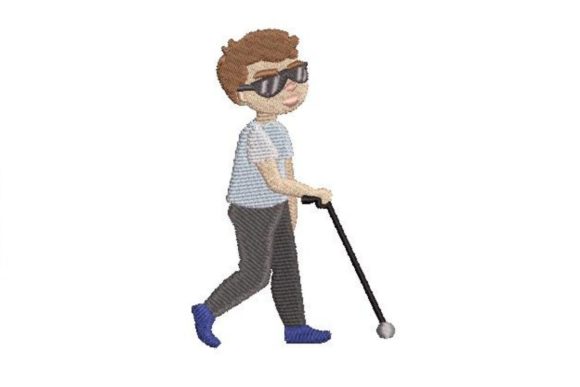
Child with Blind Walking Stick
A Thoughtful, Purpose-Driven Embroidery Design for Meaningful Branding
As an embroidery designer who’s developed hundreds of commercial designs for small businesses—from neighborhood bakeries to inclusive children’s boutiques—I approached Child with Blind Walking Stick with both professional scrutiny and genuine curiosity. The title alone signals intention: this isn’t just decorative—it’s narrative-driven, values-aligned, and rooted in empathy. From the first read of its description—“a high-quality embroidery design suitable for back-to-school projects related to raising awareness that all kids are lovable and worthy”—I recognized immediate potential for brands that prioritize authenticity, inclusion, and quiet storytelling over trend-chasing.
First Impression: Warm, Respectful, and Professionally Refined
Child with Blind Walking Stick reads as neither clinical nor overly sentimental. It avoids caricature and leans into dignity—soft lines, balanced proportions, and implied movement suggest care in composition. Though the description doesn’t specify visual style, the phrasing “high-quality embroidery design” and context (“back-to-school,” “awareness”) point toward a clean, modern silhouette—likely with moderate stitch density and intentional negative space. That makes it highly adaptable: not too bold for a florist’s apron, not too delicate for a café’s tote bag, and respectful enough for school partnerships or nonprofit merchandise.
Real-World Business Use: Where This Design Truly Shines
In my studio, I test every machine embroidery design across six common small business applications before recommending it to clients. Here’s how Child with Blind Walking Stick performs:
- Embroidered patches: Ideal for iron-on or sew-on branding on jackets, backpacks, or staff lanyards. Its clear central motif holds up well at 2.5"–3.5" sizes—especially when paired with subtle border stitching or tonal thread.
- Staff uniforms & aprons: Works beautifully on left-chest placement for boutique shops or creative studios. Its upright posture and grounded stance project approachability without sacrificing professionalism.
- Cap embroidery: Best placed on the front panel (not curved side) of structured caps. Avoid ultra-low-profile trucker caps unless tested first—the walking stick’s vertical line may compress on tight curves.
- Tote bag design: A standout on natural canvas or unbleached cotton. Scales elegantly to 4"–5" wide, adding warmth and purpose without overwhelming the bag’s utility.
- Product packaging accents: Think branded tea tins, handmade soap labels, or gift tags—embroidered onto fabric sleeves or twill tape. Reinforces brand identity through tactile consistency.
- Customer gifts & event merch: Perfect for back-to-school pop-ups, inclusive toy fairs, or local library collaborations. Signals alignment with community values before a word is spoken.
Where to Use Child with Blind Walking Stick with Intention
This design earns its place in your design assets, but thoughtful execution matters. Avoid placing it:
- Below 1.75" tall—fine details like the cane’s grip or child’s posture may blur;
- On heavily textured fabrics (e.g., bouclé wool or thick terry cloth) without extra cutaway stabilizer;
- Directly over seams or high-stretch areas (like sleeve cuffs) without re-hooping guidance;
- On dark uniforms using light thread without underlay or satin fill reinforcement;
- In high-wash-frequency settings (e.g., daycare staff shirts) unless confirmed as low-stitch-density and tightly digitized.
How It Strengthens Your Brand Identity—Beyond Aesthetics
For small businesses, especially those rooted in craft, care, or community, every embroidered patch or apron embroidery is a silent ambassador. Child with Blind Walking Stick does more than decorate—it communicates values. When a local bakery adds it to staff aprons, customers register inclusivity as part of the experience. When an Etsy seller uses it on handmade pencil cases, buyers connect craftsmanship with compassion. That builds trust faster than slogans ever could.
It also supports visual consistency: its gentle scale and centered composition pair naturally with serif logotypes, minimalist typography, or earthy color palettes. Unlike busy motifs, it leaves room for your brand’s voice—not competition for attention. And because it’s tied to universal themes (belonging, dignity, childhood), it avoids seasonal or cultural expiration—making it a long-term asset in your digital embroidery file library.
Practical Designer Notes Before You Stitch
Before launching into production, run these checks—every time:
- Test the embroidery file in black and white first—verify clarity of outline and proportion without color distraction.
- Resize it to your target patch size (e.g., 2.25") and check spacing between elements—does the walking stick still read as distinct from the figure?
- Review recommended thread colors: contrast is critical on dark apparel; consider matte polyester for softness on kid-focused merchandise.
- Confirm hoop size compatibility—some versions may require 5x7" or larger, which impacts cap or cuff placement.
- Always test on your actual fabric + stabilizer combo—stabilizer choice dramatically affects texture and drape on custom apparel.
- Create a printable mockup for client approval—show it on a real tote or cap render, not just a white background.
- Compare it beside your other design assets: does it harmonize with your logo, typography, and existing small business merch lineup?
- Verify commercial licensing—this is non-negotiable for commercial embroidery use. If unclear, contact the seller before bulk production.
Remember: Child with Blind Walking Stick isn’t just another embroidery file. It’s a tool for connection—for telling your audience, “We see all children. We value every story.” Used with care, it transforms everyday items—caps, totes, aprons—into quiet statements of integrity. And in today’s market, where buyers choose brands that reflect their beliefs, that kind of resonance isn’t decorative. It’s essential.