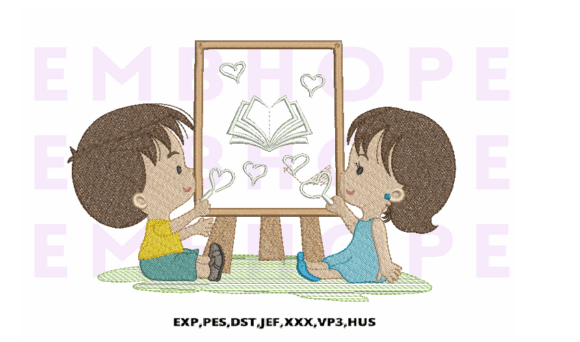
Children Drawing Embroidery Design
First Impression: Sweet, Approachable, and Perfectly On-Theme
As an embroidery designer who’s prepped over 200 craft fair booths—and shipped thousands of finished products—I opened Children Drawing expecting charm, and it delivered. The title alone signals softness, innocence, and hand-drawn authenticity—no stiff clipart vibes here. Based on the description (“This Cute Drawing will add a lovely accent to any fabric”), it reads as gentle, modern-cute—not overly whimsical or cartoonish, not minimalist or stark. It lands right in that sweet spot for Back To School season: friendly enough for kids’ items, refined enough for adult-led handmade goods like linen aprons or ceramic-mug gift sets.
Where Children Drawing Shines on Craft Fair Products
In my booth setup, I always lead with tactile variety: tote bags slung over hooks, folded tea towels stacked beside embroidered pouches, pillow covers propped upright, and patches pinned to a sampler board. Children Drawing performs strongest when treated as a small-to-medium focal accent—not a full-cover motif. Here’s how it holds up across key categories:
- Tote bag design: Works beautifully centered on the lower front panel (10–12” wide). Draws eyes without overwhelming the canvas—especially on natural canvas or oat linen.
- Apron embroidery: Ideal above the pocket or on the bib. Its soft lines complement the utility-meets-charm appeal of handmade aprons.
- Tea towel embroidery: A standout on flour-sack cotton—clean background + light stitch density = crisp readability. Avoid heavy terry or looped textures unless you double-stabilize.
- Embroidered patch: Excellent candidate. Clean outer shape and moderate detail translate well to iron-on or sew-on formats. Customers love grabbing these as impulse buys.
- Fabric pouch & small market bag: Perfect scale for 4–6” surfaces. Adds personality without competing with functional zippers or seams.
- Pillow cover & cap embroidery: Use with caution—curved cap surfaces and tight pillow corners demand careful hooping. Test on scrap first.
What Makes Children Drawing a Smart Craft Fair & Etsy Seller Choice
This isn’t just “cute”—it’s commercially intuitive. At a glance, customers understand it: no decoding needed. No tiny lettering, no dense fill areas that blur on dark fabric, no fragile linework that frays after two washes. That clarity means faster decision-making at your booth—and higher conversion on Etsy listings where shoppers scroll in under three seconds.
Photography is effortless: it pops against neutral backdrops and reads cleanly in thumbnail size. For digital sellers, that translates directly to stronger printable mockup performance—your design assets look polished even before stitching.
Batch production? Yes. Children Drawing avoids excessive jump stitches and extreme thread color changes, making it efficient for multi-hoop runs. It feels repeatable—not “samey,” but reliably charming across product types. That consistency builds brand recognition fast, especially if you pair it with a cohesive palette (think: oat, sage, sky blue, and warm cream thread colors).
Careful-Use Notes Every Embroiderer Should Know
Even sweet designs have limits—and skipping these checks risks wasted fabric, frustrated customers, and booth returns. With Children Drawing, pay close attention to:
- Fabric texture: Avoid highly napped or ribbed fabrics (like some brushed twills or thick terry) unless you use cutaway stabilizer and reduce top tension.
- Dark fabric: The description doesn’t specify thread contrast, so test your chosen colors on black or navy fabric. Light threads may fade; metallics may overwhelm.
- Small-scale applications: While it works well as an accent, shrinking below 3.5” risks losing definition—especially if original machine embroidery design includes fine interior lines.
- Resizing warnings: The note “quality cannot be guaranteed when resizing” is critical. Never scale this digital embroidery file beyond ±15% without re-digitizing or at least verifying stitch density and pull compensation.
Designer-Level Production Checklist Before You Stitch
I treat every embroidery file like a prototype—not a final asset. Before cutting into your best linen or loading ten hoops, do this:
- Test stitch on scrap fabric matching your target product (e.g., tea towel weight, cap twill, pouch canvas).
- Check thread contrast—especially where light fills meet dark backgrounds.
- Review spacing between elements: does it breathe, or feel cramped next to seams or hems?
- Confirm hoop size compatibility—some versions may require larger hoops than your standard 4×4.
- Inspect stitch density: high-fill sections can stiffen lightweight fabrics, undermining drape on totes or pouches.
- Choose stabilizer wisely—tear-away for stable wovens, cutaway for knits or textured towels.
- Create at least one real-life finished product mockup—not just digital. Drape it, hold it, photograph it in natural light.
- Compare thread colors across fabric swatches—what looks warm on white may read cool on oat.
- Verify commercial licensing status. If selling physical handmade product, ensure your license permits finished-goods resale—not just personal use.
Final Thought: Why Children Drawing Belongs in Your Back To School Lineup
This isn’t filler—it’s a quiet confidence-builder. In a crowded craft fair aisle or a saturated Etsy search for “back to school embroidery,” Children Drawing stands out by being kind: kind to your machine, kind to your timeline, kind to your customer’s eye. It elevates a simple tea towel into a giftable moment. It turns a plain cap into a conversation starter. It gives your booth warmth without clutter. For small shop product creators, boutique makers, and Etsy sellers building a signature style, it’s not just another embroidery file—it’s a reliable, repeatable expression of handmade care. Stitch it thoughtfully, display it proudly, and watch it become a steady seller—week after craft fair week.