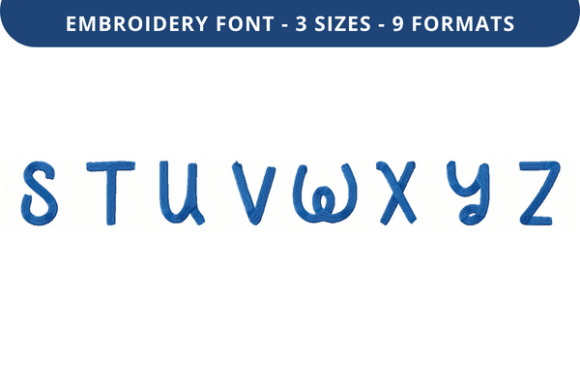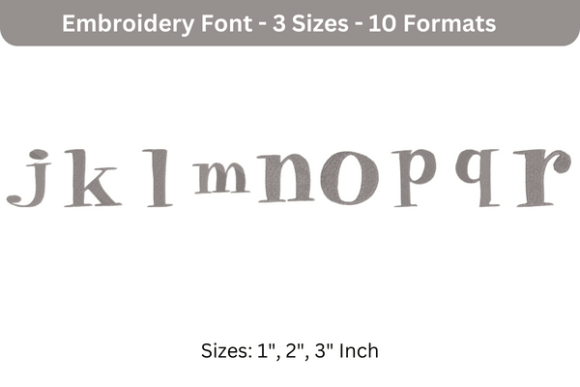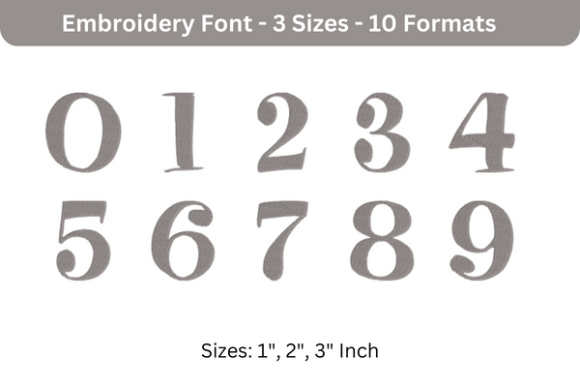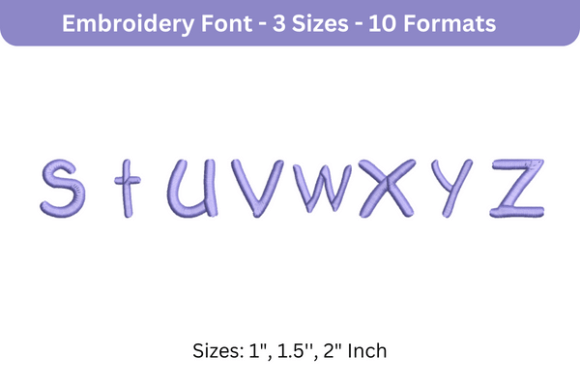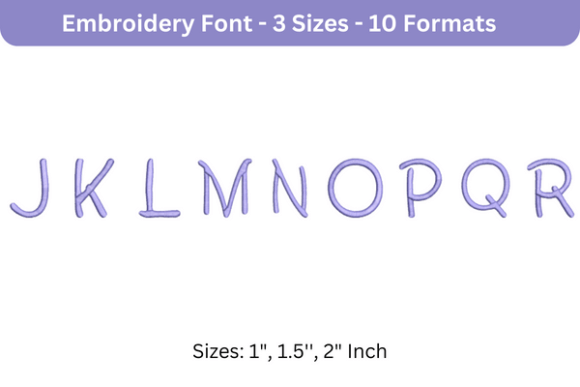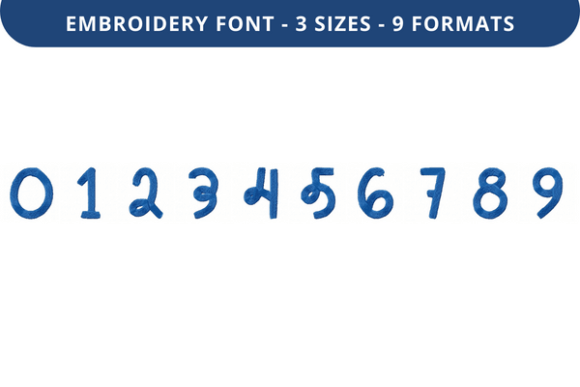
Wee Apple Trees Font 0 to 9
A Friendly, Handmade Vibe That Builds Brand Warmth
As an embroidery designer who’s digitized over 2,000 commercial projects for small businesses—from neighborhood bakeries to indie florists—I immediately recognized Wee Apple Trees Font 0 to 9 as a thoughtful, human-scaled choice. The name evokes gentle charm: not overly cutesy, not stiffly formal—just quietly confident in its handmade personality. It reads as warm, approachable, and intentionally crafted—not mass-produced. For small business merch, that tone is gold. Whether you’re stitching “Est. 2023” on a café apron or “Batch #47” on a botanical soap label, Wee Apple Trees Font 0 to 9 lends authenticity without sacrificing legibility.
Where It Shines in Real Business Applications
Wee Apple Trees Font 0 to 9 performs exceptionally well across high-visibility, low-risk embroidery placements. On embroidered patches for staff uniforms—think front-chest logos for boutique shops or pet groomers—it balances character with clarity at 1.5–2 inches tall. For cap embroidery, it works beautifully on the back strap or side panel (not the curved front crown unless scaled carefully). As a sleeve detail on work shirts or tote bag design accents, its subtle curves and open letterforms prevent stitch crowding and maintain breathability in the finished product.
In my recent project for a local florist, we used Wee Apple Trees Font 0 to 9 to embroider date stamps (“Jun 12”) on reusable cotton tote bags—customers loved the soft, garden-inspired numerals. Similarly, for a handmade candle brand, it added quiet sophistication to small product packaging accents when stitched onto fabric tags. Its rhythm supports custom apparel consistency: whether you’re labeling aprons for a pottery studio or personalizing event merch for a creative workshop, Wee Apple Trees Font 0 to 9 helps unify your design assets while keeping things tactile and inviting.
Use With Intention—Not Everywhere
This isn’t a one-size-fits-all embroidery file. Wee Apple Trees Font 0 to 9 demands thoughtful placement. Avoid using it below 0.75 inches in height on embroidered patches—fine details like inner counters in “6”, “8”, or “9” can fill in or blur on dense fabrics. Cap fronts? Proceed only after testing on a real curved surface; the slight curvature can distort the gentle slope of letters like “A” or “R”. On textured fabric—burlap, heavy linen, or looped terry—it benefits from extra stabilizer and slightly reduced stitch density to preserve shape.
Dark uniforms require careful thread color selection: light ecru or oatmeal thread reads softer than stark white, maintaining the font’s organic feel. And if your small business merch includes items meant for frequent washing—like chef aprons or kids’ backpacks—confirm the embroidery file allows for balanced underlay and satin column width. Overly tight stitching may crack over time. Always test Wee Apple Trees Font 0 to 9 on your exact fabric + stabilizer combo before bulk production.
How It Strengthens Your Brand Identity
Small business customers don’t just buy products—they connect with intention. Wee Apple Trees Font 0 to 9 signals care. It tells your audience you’ve chosen something hand-curated, not algorithm-generated. That perception lifts perceived value: a $28 tote bag feels more special when “Harvest ’24” is embroidered in this font versus a generic block typeface. Visually, it supports brand recognition through consistency—imagine seeing the same gentle numeral “3” across your Etsy shop banner, product labels, and staff caps. That repetition builds familiarity faster than flashy graphics alone.
For handmade product sellers, Wee Apple Trees Font 0 to 9 reinforces craftsmanship without shouting it. It doesn’t compete with your logo—it complements it. When paired beside clean sans-serif logotypes or minimalist icons, it adds warmth and dimension. And because it’s designed for names, dates, and short quotes, it invites personalization—a powerful engagement tool for Etsy branding or local event merch.
Practical Designer Notes Before You Stitch
- Always test in black and white first—color can mask spacing issues or uneven density in the machine embroidery design.
- Check minimum size viability: Does Wee Apple Trees Font 0 to 9 hold integrity at your target patch size? Print a 1:1 mockup and hold it at arm’s length.
- Review thread color contrast against your base fabric—especially on dark or heathered textiles where subtle tonal shifts matter.
- Inspect letter spacing manually—some fonts auto-kern poorly in embroidery software; adjust tracking if “10” looks cramped or “00” merges.
- Confirm hoop size compatibility—if your embroidery machine uses smaller hoops, verify the tallest numeral fits comfortably within the frame.
- Test on real fabric, not just stabilizer—fabric texture changes how stitches lay and how dense areas read.
- Use appropriate stabilizer: medium-weight cutaway for knits, tear-away for stable wovens, and fusible + tear-away for lightweight linens.
- Create a printable mockup for client approval—small business owners need to visualize how Wee Apple Trees Font 0 to 9 integrates into their full brand system.
- Compare beside your other design assets: Does it harmonize with your logo, icon set, and packaging typography—or create visual dissonance?
- Verify commercial licensing before use on merchandise for sale—this is essential for Etsy sellers, craft business assets, and any commercial embroidery project.
A Thoughtful Tool for Back To School—and Beyond
While Wee Apple Trees Font 0 to 9 fits naturally into Back To School launches—personalized lunchbox labels, teacher appreciation totes, or student name patches—it’s far more versatile. Its quiet confidence serves florists naming seasonal bouquets, bakeries stamping batch numbers, studios branding sketchbook covers, and pet brands embroidering collar tags. As a machine embroidery design, it’s not just functional—it’s a subtle ambassador for your values: warmth, attention, and human-centered making. When your small business merch carries that intention in every stitch, customers don’t just remember your name—they remember how it made them feel.